Vehicle - Auto - Truck - Heavy Equipment
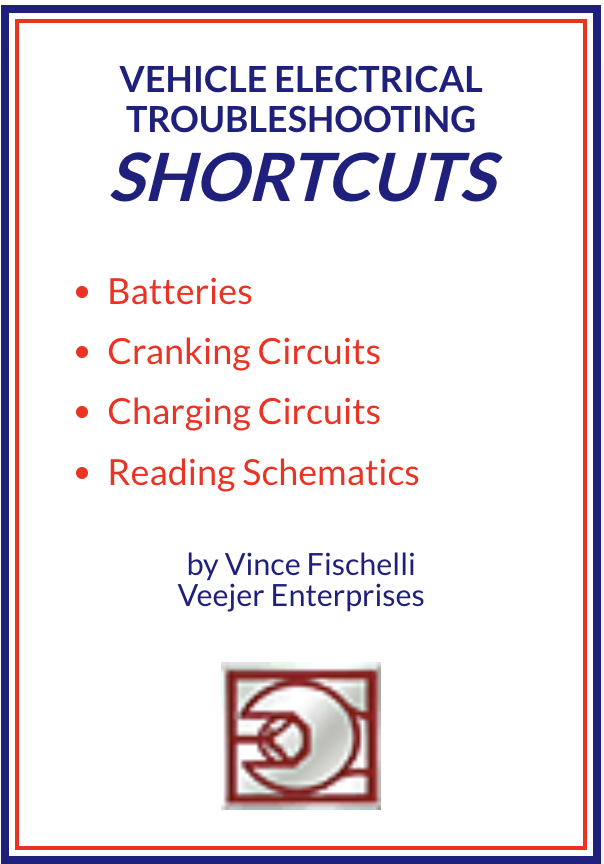
"Electrical Troubleshooting
SHORTCUTS"
The "How-To" Electrical Book!


This HOW-TO book, "Vehicle Electrical Troubleshooting SHORTCUTS," is for beginner through professional auto, truck or heavy equipment service technicians who need more practical electrical troubleshooting training. This 250 page textbook combines the electrical troubleshooting training from Vince Fischelli's, 3-Day Phase 1, Advanced Electrical Troubleshooting Workshops and Seminars combined into one volume of 250 pages suitable for home study and shop use. Packed full of how-to electrical troubleshooting procedures that work and save testing and troubleshooting time which increases your profits. No more guessing about what's causing an electrical problem.

Many have asked to buy a Phase 1 workbook since they were unable to attend a Phase 1 Workshop in Dallas. But the workbook was written to be used in the workshop, with a lecture and is not designed for self-study. Now this NEW book,
SHORTCUTS, covering the Phase 1 workshop, is available in a fully self-contained textbook.

Vince's new book is called "Vehicle Electrical Troubleshooting SHORTCUTS."
You can buy it NOW
for $78.00 plus shipping and handling.

Seven Sections cover essential electrical principles, how to use a DMM and a tutorial on how circuits really work.
SHORTCUTS then covers electrical troubleshooting techniques of battery circuits, cranking circuits and charging circuits using only a DMM and Current Clamp to perform these electrical tests on-the-vehicle. The last section explains how to read electrical circuit diagrams.

Imagine repairing vehicle electrical problems in battery, cranking and charging circuits using only a DMM and Current Clamp. No need for expensive electrical testers dedicated to tests these circuits. SHORTCUTS provides explanations on how these circuits work and presents innovative electrical troubleshooting procedures for batteries, cranking circuits and charging circuits that anyone can follow to find the cause of an electrical failure. Keep in mind, all that is needed to do this level of in-depth electrical troubleshooting SHORTCUTS and repair is a DMM and a Current Clamp.


 SHORTCUTS Content Outline

SHORTCUTS Section 1: 26 Pages - 11 Illustrations
"Essential Electrical Principles"
This first section is an introduction to essential electrical principles for those who have never studied electrical principles before. Introduction to electricity - Flashlight operates on electrical principles - The load in a circuit - Circuit ON/OFF Switch - Electrical terminology when a flashlight is OFF - When a flashlight is turned ON electron current flows - Inrush electron current - Conventional theory of current - Important electrical terminology when a flashlight is OFF - It's electron current that gets the work done - Electrical principles to remember - Electrical property of resistance - impact of resistance in a circuit - The problem caused by corrosion - The relationship between voltage and electron current - The relationship between resistance and current - The relationship between voltage, current and resistance - Ohm's Law - Introduction to schematic diagrams - Vehicle battery schematic symbols - "Schemation" diagrams - Voltage side of vehicle primary electrical system - Voltage side B+ - Ground side of vehicle voltage source B- - Dual ground system - Ground circuits.

SHORTCUTS Section 2: 34 Pages - 44 Illustrations
"Working With Digital Multimeters"
(What a DMM can do and can't do.)
Introduction to DMMs - Two types of DMMs in use - Caution reading auto ranging DMM - Converting between volts and millivolts - DMM voltage ranges - Tips using a voltmeter - DMM Current ranges - Proper use of 20A range - Tips using an ammeter - Ohmmeters in general - Human body resistance affects ohmmeter readings - Errors reading ohmmeters - Practice testing resistance with ohmmeters - Tips using an ohmmeter - Continuity test - Reading the continuity display - Conductivity vs. Continuity - Diode testing - Semiconductor diodes - How to use the diode test feature - Tips using diode test - Current clamps - Current clamp set-up - How a current clamp works - Tips using a current clamp - Frequency measurement.

SHORTCUTS Section 3: 35 Pages - 40 Illustrations
"Understanding How Circuits Work"
(How can you troubleshoot if you don't know how circuits work?)
Why study electrical circuit principles? - Water hoses in a series connection - Hose water current - Electrical series circuit - The law of (electron) current in a series circuit - Impact of resistance R1 - Current takes the path of least resistance - Measuring electron current in a series circuit - Voltage in a series circuit - How much should a Vd be? - Vd of components in a circuit - Law of voltage in a series circuit - The voltage drop of the voltage side - The voltage drop of the ground side - Law of resistance in a series circuit - Load resistance - Starter Kit H-111 trouble-shooting training - Two water hoses in parallel - Electrical parallel circuit - Law of current in parallel circuits - Current takes the path of least resistance - Measuring total electron current in a parallel circuit - Measuring individual parallel branch electron current - Law of voltage in parallel circuits - Measuring voltage inside a branch - Law of resistance in parallel circuits - Example of resistors in parallel - Compound circuit - Voltage measurement techniques - Measuring B+ - Measuring Vd of the voltage side - Measuring voltage drop of the ground side - Putting it all together - H-113 Troubleshooting DC Motor Circuits Troubleshooting Trainer.

SHORTCUTS Section 4: 34 Pages - 18 Illustrations
"QUICK
Troubleshooting Battery Circuits"
(Can you test a battery for proper cranking in 30 seconds?)
(Can you test a battery for proper charging in less than 5 minutes?)
Introduction to batteries - Battery voltage - What happens in a battery - Battery during discharge - Battery discharge circuit - Battery changes during discharge - Battery recharge circuit - The battery during recharge - Testing batteries - Cycle testing electrical circuits - Static voltage test, O.C.V. - When battery O.C.V. is 12.66V - When battery O.C.V. is suddenly down to 10.55V - When battery O.C.V. is suddenly almost zero volt - When battery O.C.V. is over 13.00V - Battery cranking voltage test - Summary of cranking voltage test - Battery cranking electron current test - Battery recharge electron current test - Carbon pile battery load test - Battery bounce-back test - Determine remaining battery life - Overview of 5-step battery test procedure.

SHORTCUTS Section 5: 30 Pages - 18 Illustrations
"QUICK
Troubleshooting Cranking Circuits"
(Can you test the cranking circuit in less than one minute and know what's the cause of a no/slow crank?)
Introduction to cranking circuits - Basic cranking circuit - Understanding starter motor current - Overview of troubleshooting cranking circuit problems - Measure cranking current or starter motor draw - Measure battery cranking voltage - 3-step cranking circuit testing procedure - When starter draw is too high - When starter draw is too low - Is there a bad connection in the wiring? - A resistance problem in the starter motor? - Pin-point a bad connection or cable on voltage side - 3-step QUICK cranking circuit troubleshooting - Cranking circuit control - Testing the solenoid control circuit - Simple cranking circuit - Failure to crank - Starter relay circuit - H-115 Troubleshooting Relay Circuits Trainer - Troubleshooting starter relay circuit - Here's a true story.

SHORTCUTS Section 6: 47 Pages - 30 Illustrations
"QUICK
Troubleshooting Charging Circuits"
(Can you test the charging system in 60 seconds and know if there is a charging voltage problem? Can you tell if a battery knocked out the generator you just replaced? Do you know how to test a generator when it is controlled by an on-board computer?)
Introduction to generator/charging systems - Overview of the charging system - Inside a generator - What a generator does - Interpreting the charging voltage - Three factors that affect the charging voltage - Generator voltage tests - Generator electron current tests - The charging voltage test - When charging voltage is too high or too low - Understanding generator/battery current test - Measuring battery recharge electron current - Factors that determine battery recharge current - How to measure battery recharge current - What's good - What's bad - Read the DMM correctly - Determine if a battery is defective when recharging - Try this simple experiment - The conclusion of measuring battery recharge current - Generator ripple voltage test - Lab scope test of generator output - Overview of testing vehicle charging system - Evaluating charging voltage test results - The wrong way to test a generator - Two major problems with the generator load test - Computer controlled generator - How an on-board computer controls the generator - Here's the problem - Testing resistance of rotor/field winding - Hot and cold resistance Evaluating/calculating rotor/field winding condition - rotor/field windings may be internally grounded - Introduction to PWM (pulse-width-modulation) - PWM duty cycle - PWM rotor/field winding control.

SHORTCUTS Section 7:18 Pages - 9 Schematic Diagrams to study . . .
"Reading Schematic Diagrams"
"What does a schematic diagram tell you and what does it not tell you?)
How to read a schematic diagram - What a schematic diagram can do - "Schemation" of a vehicle's primary electrical system - inventory of a circuit diagram - Trace the path of electron current - Measure the voltage around the circuit - Physically trace the circuit lines - Exercise 7-3: Reading a relay controlled cooling fan circuit diagram - How the circuit works - Troubleshooting the circuit on paper - Exercise 7-4: Reading a relay controlled cranking circuit diagram - How the circuit works - Troubleshooting the circuit on paper - Exercise 7-5: Reading a relay controlled horn circuit diagram - How the circuit works - Troubleshooting the circuit on paper - Exercise 7-6: Reading a rear compartment relay controlled lid release circuit diagram - How the circuit works - Troubleshooting the circuit on paper - Exercise 7-7: Reading a relay controlled window defogger circuit diagram - How the circuit works - Troubleshooting the circuit on paper - Exercise 7-8: Reading a relay controlled window/washer pump motor circuit diagram - How the circuit works - Troubleshooting the circuit on paper - Conclusion reading schematic/schemation diagrams.


 SHORTCUTS is available for immediate shipping. Buy It Now!
250 pages of electrical troubleshooting information with step by step Troubleshooting Worksheets to practice testing batteries, cranking circuits, and charging systems on-the-car with only a DMM and Current Clamp. A section on how to read schematic diagrams is included. All sections have review exercises with answers in the back of the book.


Return to Veejer Enterprises Home Page
Return to The Shop Owner's/Fleet Manager's page
Return to Teacher's page
Return to 60 Lessons page

Return to Hands-On Troubleshooting Training page

Veejer Enterprises
Garland, Texas, U.S.A.
Phone:  972-276-9642
Fax:     972-276-8122

Email:  
contact-us@veejer.com